
You settle her in fifteen minutes. Then you lie awake for ninety. Here is what is actually happening.
It is not the feed, it is not your age and it is not that having a baby broke something in you. It is the light you switch on to get there, and there is now a fair amount of evidence about it.
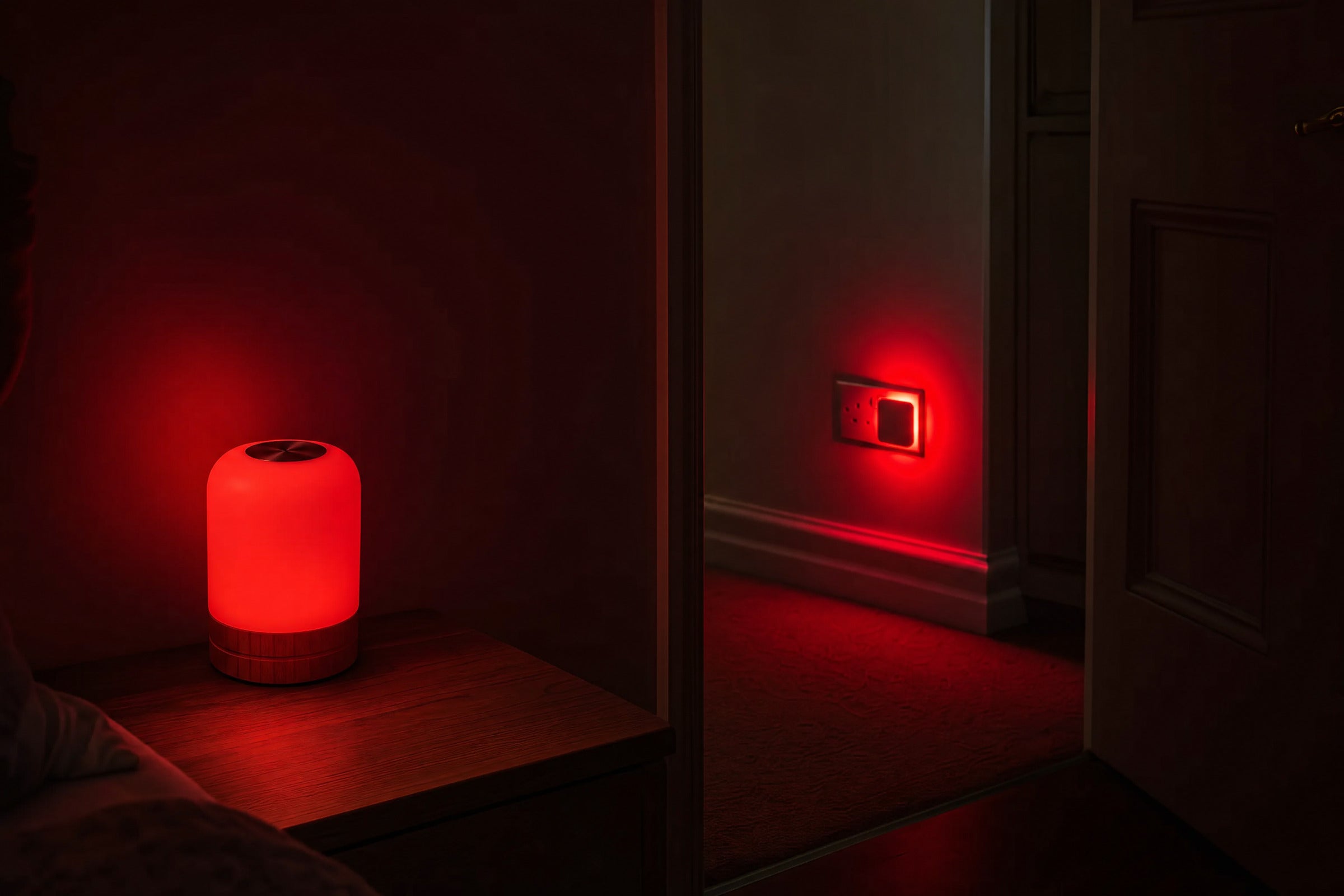
It is 2:47am. Your baby is crying. You get up, flick the light on, do the feed, settle your baby, put them back down. Fifteen, twenty minutes later you are back in bed.
And then nothing happens.
You lie there. Wide awake. Heart rate normal, body exhausted, brain absolutely refusing to switch off. An hour goes by. Maybe more. You are staring at the ceiling doing that thing where you try to force yourself to sleep, which never works, while you count down the hours until the alarm goes off and you have to function like a person.
Then you do a whole day on it. The early start. Snapping at someone who did not deserve it. The bit in the afternoon where you cannot hold on to a word anyone is saying. And then you do it again tomorrow night, and the night after, because none of it is optional.
Over three months, that adds up to roughly a working week of sleep you never got. And it may be the most fixable thing in your whole night.
Your brain thinks it is daytime. It is not.
Here is the part nobody tells new mums, and it takes about ten seconds to explain.
Your brain has a hormone called melatonin whose entire job is to keep you asleep. The moment a normal white or blue-toned light hits your eyes, a lamp, an overhead light, even a phone screen on the way to the cot, a receptor behind your retina called melanopsin picks it up and tells your brain: it is daytime, stop producing melatonin, wake up properly.
Your brain listens. Melatonin production drops within minutes. And once it is gone, it does not come back the second you turn the light off again. It has to be rebuilt.
That is the hour and a half of ceiling-staring. That is the brain fog that is still there at 9am when you are trying to hold a conversation and function on a school run.
You did not fail at falling back asleep. Your brain was told, correctly, that it was daytime. It was doing exactly what you told it to do.

Melanopsin peaks in the blue, around 490nm, and by the deep red end it has almost nothing left to respond to. That gap is the entire reason a red light works at 3am. Data: CIE S 026:2018, the international standard lighting engineers work from.
This has been measured, and the gap is not subtle
In 2025 a team at the University of Zaragoza ran the experiment directly. Twelve adults, two separate nights each. One night under a red light, one night under a blue light, both at exactly the same brightness at the eye, 9pm to midnight. Saliva tested every hour.
Two hours in, melatonin under the blue light was sitting at 7.5. Under red it had climbed to 26.0. Roughly three and a half times higher. At the third hour it was 16.6 against 8.3, exactly double. Both differences were statistically significant.
Same room, same brightness, same people. The only variable was the colour of the light.

Under red, melatonin climbs back while the light is still on. Under blue, it stays on the floor. Twelve healthy adults, both lights at 80 lux at the eye, each person tested under both colours. Sánchez-Cano and colleagues, Life, 2025.
Only the white light
Which light suppressed melatonin in a seventeen-person night study
A separate study ran seventeen people through three weeks of night-time testing under red light, white light and dim light.
Both the red and the white light made them measurably sharper. Faster reaction times, less drowsiness on the EEG. But when the melatonin results came back, only the white light had suppressed it.
You can have the light you need to function at 3am without paying for it with the hormone that puts you back under. That is the whole proposition, in one result.
The fix sounds too simple to be true (it is not)
Red and amber light, the long end of the visible spectrum, does not trigger that same melanopsin response. You can see clearly enough to feed, change a nappy, check a temperature or find a dropped dummy on the floor, without your brain ever getting the wake up, it is morning signal.
This is not a wellness trend. It is basic photobiology, and it is the same principle sleep labs and hospital night shifts have used for years. The difference is that nobody had packaged it into something you would actually want on your landing, let alone by your bed.
So a lot of mums figure it out the hard way. A red bulb ordered off a marketplace that turns out to be a warm white bulb with red-tinted glass over it, still leaking the blue wavelengths that started the whole problem. A muslin cloth draped over a lamp, which works until it slips off or you cannot see well enough to do anything. A dimmer switch taped down at 2am by someone too tired to think straight, which stops working the second the tape gives out. And the one nobody admits to, using your phone as a torch, when your phone is the worst offender in the house.
Then there is the one that catches the mums who did their homework: a light that is genuinely red, at the wrong red. Dodge the tinted ones, buy a real red LED, and the number on the box still matters. On CIE S 026, the international standard lighting engineers work from, the melanopic weighting at 630nm is roughly twenty-one times higher than at 670nm. Both sit far down the curve, and both figures come off the modelled tail of that standard, so treat twenty-one as an order of magnitude rather than a decimal place. The direction is not in dispute though, and what the gap buys is headroom: at 670nm you can have something like twenty times more light before you reach the same melanopic dose.
Most red night lights are 620 to 630nm, because that is the cheap, high-volume LED bin. The Driftback lamp runs on a genuine 670nm emitter, a part that has to be ordered on purpose. That is why the wavelength spend went on the lamp: it is the light you sit under for twenty minutes, not the one you walk past for four seconds. It still has to be dim, because a bright 670nm lamp can out-stimulate a dim 630nm one. The wavelength buys headroom, not permission.
The instinct is right. The tools people are cobbling together to act on it are not.
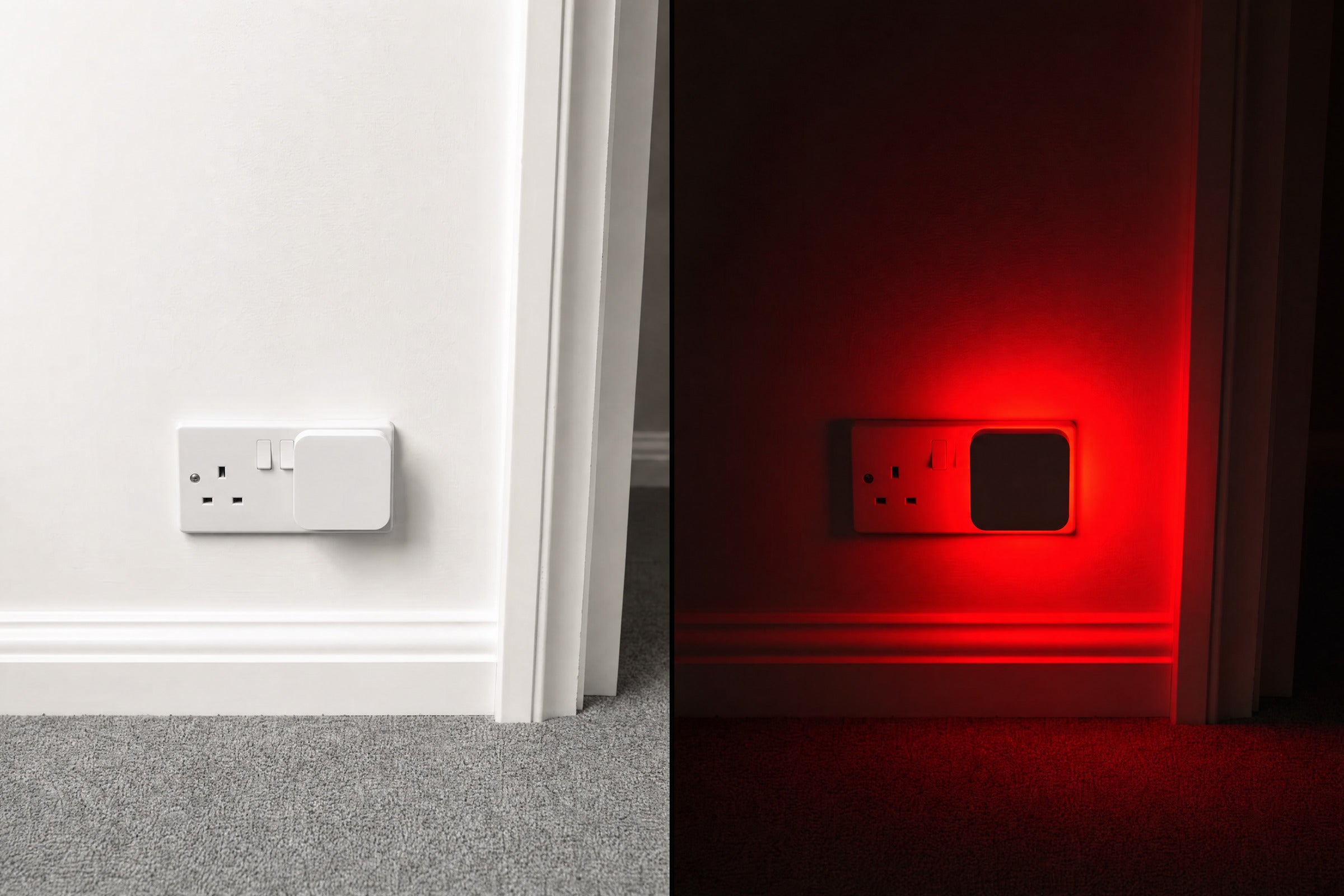
The same landing, two different decisions. A standard ceiling bulb runs at roughly 800 lumens. The Driftback wall light tops out at 60. You can see what you are doing under both. Only one of them reads as morning.
Two moments, two lights, one system
There are actually two separate problems happening on a night wake, and most attempts at a fix only solve one of them.
Getting there. Walking a dark hallway at 3am, one arm full of baby, trying not to trip over anything or wake the whole house by turning on a hallway light. You need something hands-free that switches on when you walk past it and switches off when you do not need it any more.
Being there. Sitting with your baby for the feed, or the settle, or the quiet ten minutes of I am here. You need a proper, steady light you can actually see by, that dims low enough to feel calm, and that does not undo the whole point of the exercise.
That is why Driftback is not one product. It is a two-piece system, built for the two different moments of a night wake.
The motion-sensor plug-in light goes in the hallway or by the door. It senses you coming from up to five metres away, lights your path in a soft red glow, hands completely free, then switches itself off 60 seconds after you have gone. No fumbling for a switch, no waking anyone else up.
The 670nm touch lamp sits on the nightstand or changing table. One touch gives you true red or a warm 1700K amber, both genuinely blue-free, not a tinted cover over a white bulb, adjustable so you have got enough light to see what you are doing without flooding the room. No flicker, no noise, no app, no faff. Rechargeable, so it goes wherever the feed happens to be that night.
Path light. Feed light. The two moments, covered, without you having to build it yourself out of muslin and hope.
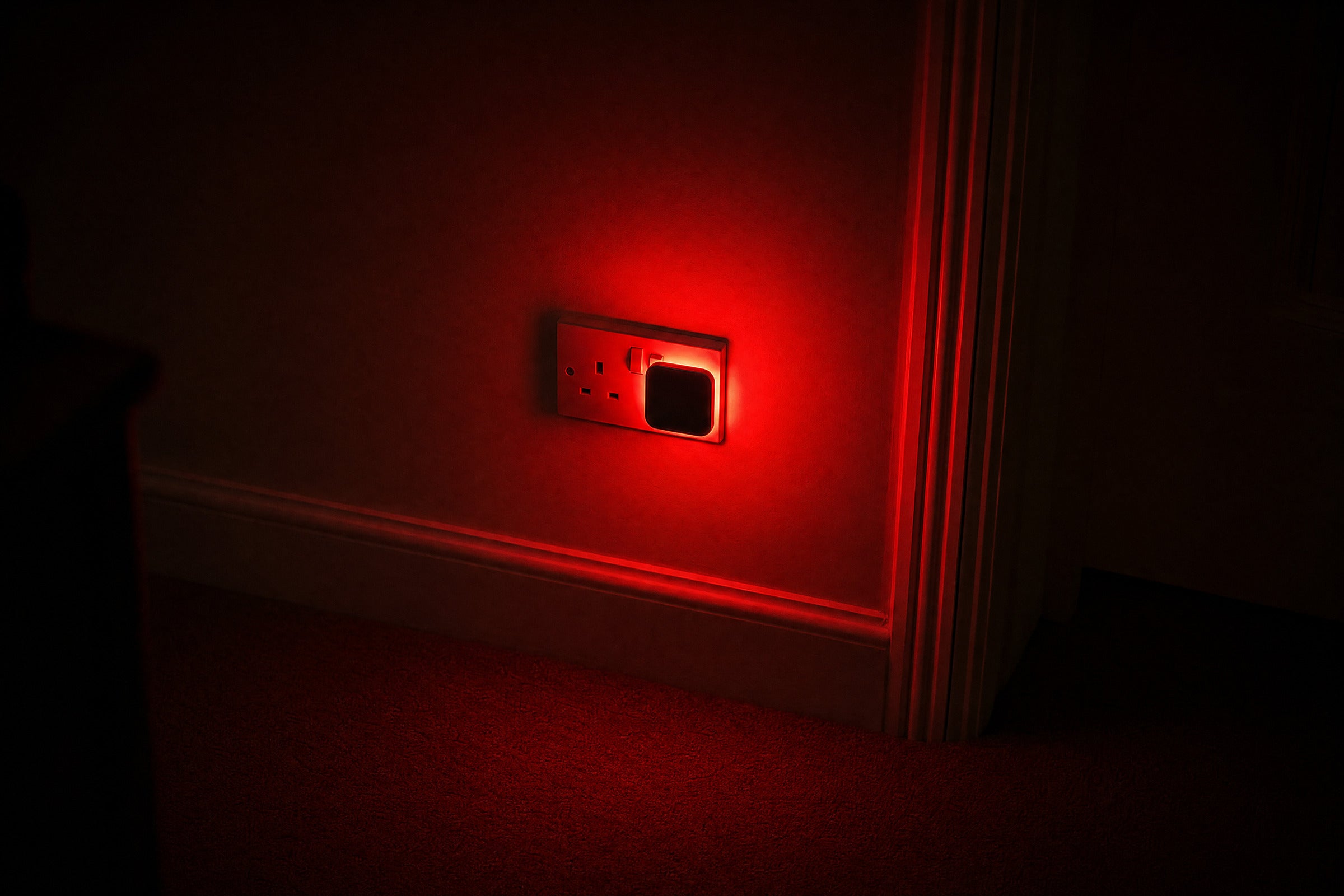
Three to five metres of sensing range, on before you reach it, out sixty seconds after you have gone. It plugs into any UK socket and there is nothing to set up.
Is red light all right around a baby?
It is the question we get most, so here is the plain answer.
These are ordinary consumer lamps, not therapy devices. No ultraviolet, no lasers, no medical claims attached. What actually matters is how much light you are putting into the room, and this is where they are unusual: the wall light runs at 1 to 50 lumens. A normal landing bulb is around 800. You are adding less than a tenth of the light, at the end of the spectrum the body reacts to least.
And the same logic applies to them, not only to you. Small children appear to be more sensitive to light than adults, not less. In one study of ten preschoolers, an hour of bright light in the evening cut melatonin by around 88 percent, and it was still down almost an hour after the light went off. Less light, and longer wavelengths, is the sensible direction for everyone in the house.
Point it away from the cot, keep it on the lowest setting that lets you see what you are doing, and it is doing the same job for them that it is doing for you.
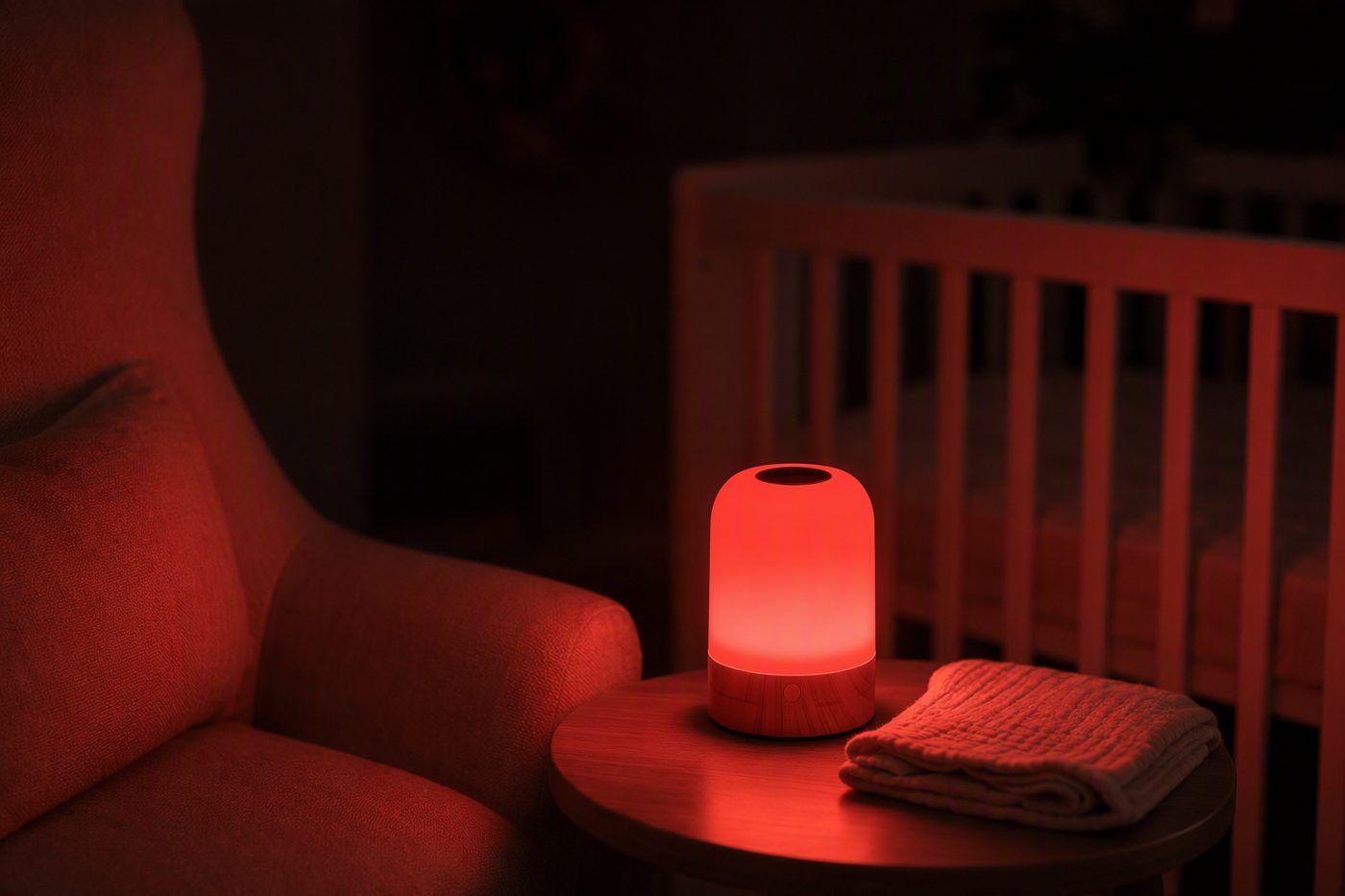
Turned down low and pointed away from the cot. The lowest setting that lets you see what you are doing is the right setting, for you and for them.
What you are actually getting
- The motion-sensor night light, hands-free, 3 to 5 metre range, 120 degree sensing angle, auto-off after 60 seconds
- The 670nm touch lamp, true red and 1700K amber settings, adjustable brightness, silent, no flicker, rechargeable
- Neither light triggers the melanopsin response that white and blue light does, so the light that helps you see does not cost you your chance of getting back to sleep
- No app, no subscription, no smart-home setup. You plug it in tonight and it works tonight
- Free UK delivery on orders of £50 and over, and thirty nights to find out. Use them as the only light you switch on at night, and if nothing changes, we refund you in full
The set most people want is called The Night Path: two motion-sensor wall lights for the route, and one 670nm bedside lamp for the feed. £59.74, which clears the £50 free-delivery threshold, so it lands at no extra cost. There is a smaller pair if you only need the corridor covered, at £4.99 delivery since it comes in under that threshold, and a bigger set for a house with more than one landing. But the hallway is not where you lose the hour. The feed is, which is why the lamp is in this one.
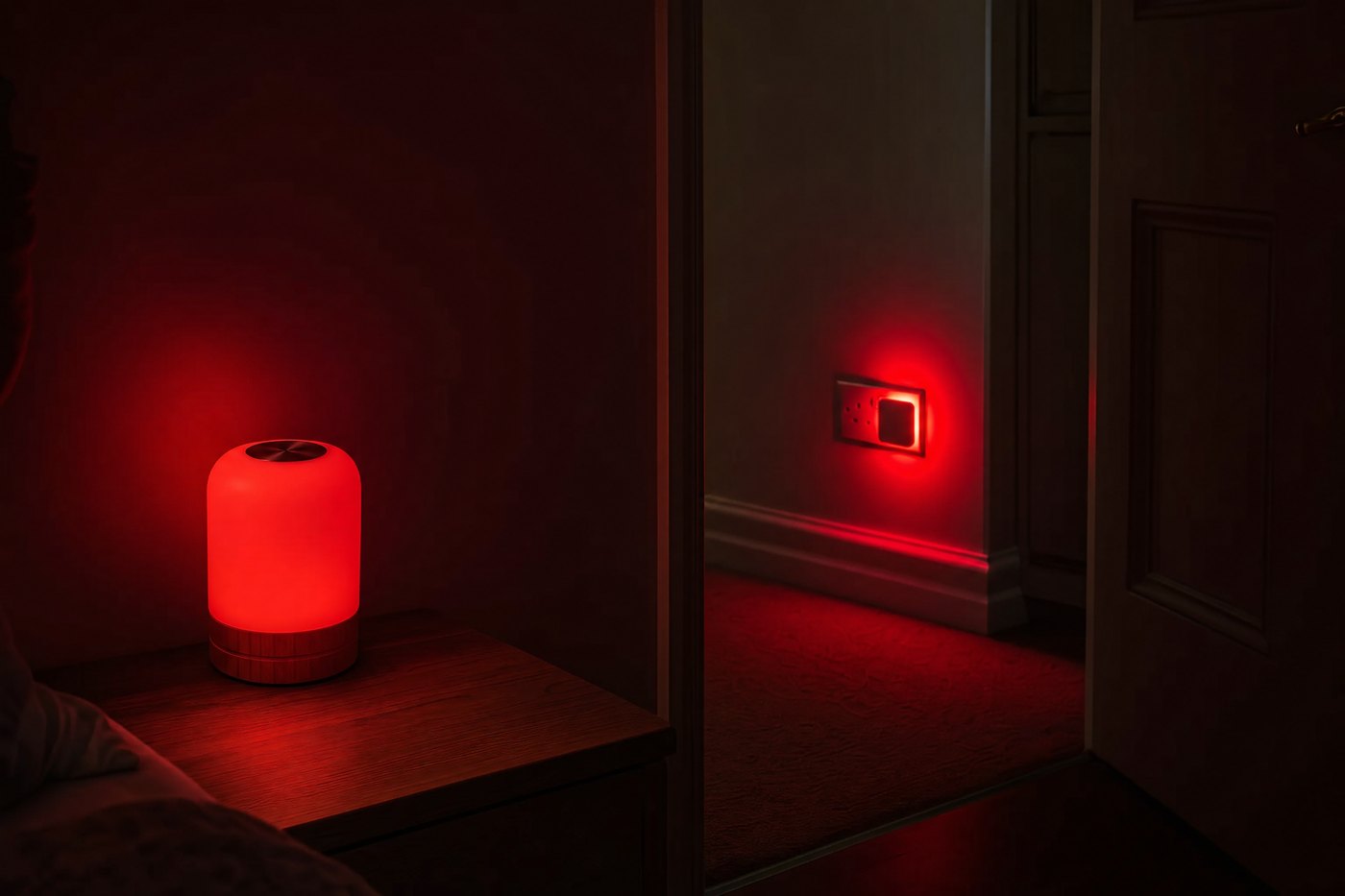
The Night Path. Two motion-sensor wall lights for the route, one 670nm lamp for the feed. £59.74, delivered free, and thirty nights to try them properly.
"But does it actually work?"
Fair question, and you should ask it.
Start with what is not in dispute. Melanopsin, the receptor that tells your brain it is morning, fires within minutes under white or blue-toned light and barely reacts to red and amber. That is not a Driftback claim, it is how eyes work, whoever is selling the light. It is why sleep labs and hospital night shifts have run on red for years.
Then the measurements above. Twelve adults, red against blue at matched brightness: melatonin three and a half times higher under red at two hours, exactly double at three. Seventeen people in a separate night study: red light made them measurably sharper, and only the white light suppressed melatonin.
What is different here is not the science. It is that somebody finally built it for the hallway and the feed, instead of leaving you to approximate it with a marketplace bulb.
And you have thirty nights to hold us to it. Use them properly, which means they are the only light you switch on when you get up. Not the landing light as well because you were in a hurry, and not the phone screen while you feed. This whole page is about what reaches your eyes, so if a white light reaches them anyway you have not tested anything. Do it properly for thirty nights and if it has not changed how fast you get back to sleep, tell us and we will refund you in full. Delivery on it is free, so the only thing you put in is the nights you spend finding out. We would rather these lights got used than shut in a drawer.
Nothing is wrong with you. The wavelength was wrong.
You have probably already told yourself a dozen different stories about why you cannot get back to sleep after a night wake. Your age. Your stress levels. The fact that this is how it is with a baby.
Here is the more boring, more fixable truth: for a lot of mums, it is the light. Change what hits your eyes at 3am, and the hour and a half of ceiling-staring stops being part of the deal.
Your baby is going to wake you tonight. That part is not up for negotiation. The only thing you get to decide is what you switch on when it happens: a light that tells your brain it is morning, or two that do not.
Decide it now, while you are awake enough to decide anything. At 3am you will not be.
Plug it in tonight.
Two moments. Two lights. Neither one tells your brain it is morning. UK delivery is free on orders over £50, which The Night Path clears, and you get thirty nights to try them properly. Make them the only light you switch on when you get up, and if that does not change how fast you get back to sleep, we refund you in full. You will be woken again tonight either way, so the only thing left to choose is what you reach for when it happens. Make that choice now, at a reasonable hour, with a clear head.
Get The Night Path, £59.74This is an advertisement for Driftback. UK delivery is free on orders of £50 and over, otherwise £4.99. The 30-night guarantee applies on the terms set out in our refund policy. Lifestyle images are illustrative.